
Example Application — Industrial Manufacturing · Regulatory Technology

EU Regulation & QR Code Automation for Product Manufacturers

An infrastructure developed from applications delivered within a multinational manufacturing environment.

About the project

Starting with product data already held within the manufacturer’s existing ERP or production software, we developed a dedicated system to automate the preparation of regulatory labels, QR codes, digital product pages and product documents.

The system was designed to work alongside the existing software and processes. Product information is transferred from the existing system and used to generate the required physical and digital outputs automatically.

The system was used across hundreds of product models and variations.
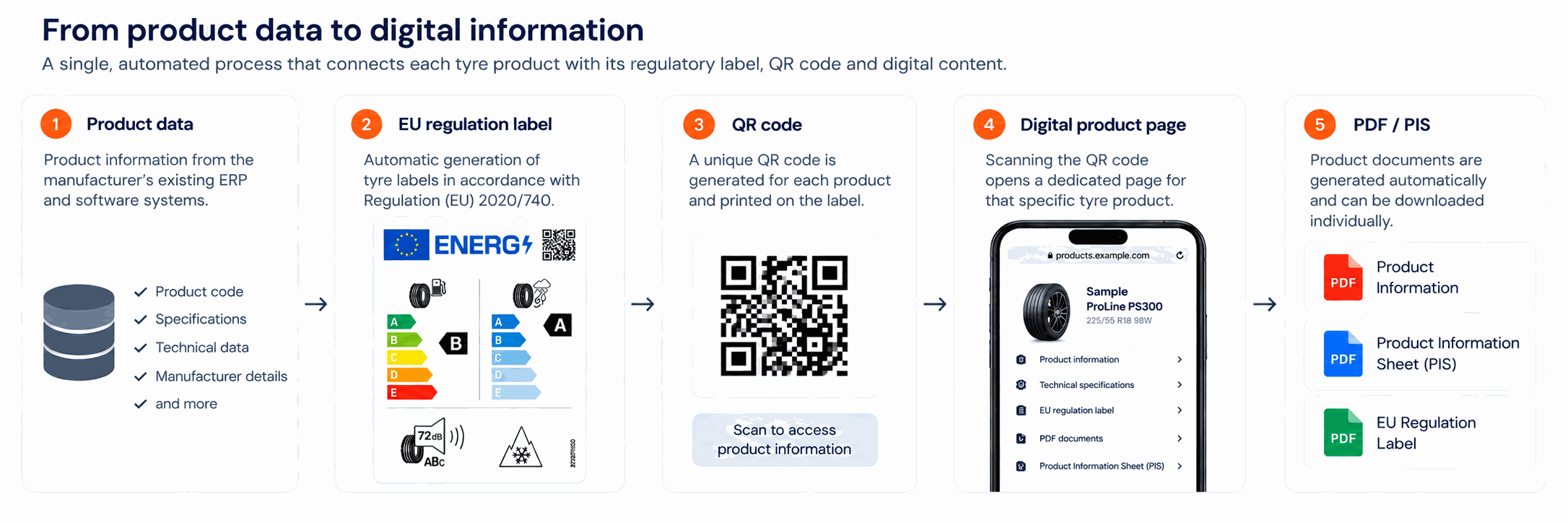
Flow diagram: product data from the manufacturer's ERP is converted into an EU regulation label, a QR code, a digital product page, and PDF or PIS documents

The need

For a manufacturer managing a large number of products, models and variations, preparing regulatory labels and product information manually can become a significant operational task.

The system needed to:

  • Use product data from the manufacturer’s existing ERP or production software
  • Automatically prepare the required product label
  • Generate a unique QR code for each product
  • Connect each QR code to the correct product information
  • Generate a digital product page automatically
  • Generate PDF and PIS documents automatically
  • Support a large number of products and product variations
  • Work alongside the existing software and production environment

The solution

We developed a dedicated regulation and digital product automation system that takes existing product data and converts it into the physical and digital outputs required for each product.

The system processes product information already held within the existing systems and automatically generates the corresponding label, QR code, digital product page and product documents.

This allows the same process to be applied consistently across hundreds of product models without requiring each output to be prepared manually.

EU Regulation-compliant tyre labelling

The system formats and generates tyre labels designed around the specifications of Regulation (EU) 2020/740 on the labelling of tyres with respect to fuel efficiency and other parameters, utilising the verified data provided by the manufacturer.

The required product information, label structure and applicable elements are generated from the product data available within the existing system. A product can be selected within the system and the corresponding label generated as a print-ready output.

QR code and digital product page

Each product is assigned a QR code connecting the physical product to its digital product information.

When the QR code is scanned, the corresponding digital product page can provide access to:

Product QR Code Digital Product Page
  • Product information
  • Technical specifications
  • Manufacturer information
  • EU regulation label
  • PDF documents
  • Product Information Sheet (PIS)

The available documents can be downloaded individually from the digital product page.

Automatic PDF and PIS generation

The system automatically generates product-specific PDF and PIS documents from the available product data.

Product data → Document template → Automatic PDF / PIS

This removes the need to manually prepare the same product documents for each model and variation.

Working with existing systems

The system was designed to work alongside the existing operational environment rather than requiring it to be replaced.

Product data already held within existing systems is synchronised with the platform and used as the source for the automated outputs. The approach allows the existing operational environment to remain in place while the new system handles the required regulatory and digital product processes.

QR interaction analytics

The platform provides analytics for QR code interactions, allowing the manufacturer to understand how its digital product pages are being accessed.

The system can provide aggregated information such as:

  • Query volume
  • Country or regional origin
  • Date and time of interaction

The analytics are designed to provide insight into product-page usage without using the system to identify individual consumers.

Ready for the Digital Product Passport

The infrastructure provides a foundation that can support a Digital Product Passport approach, bringing together product identity, product data, digital product information, a data carrier and product documentation.

As the detailed requirements for Digital Product Passports are established for the relevant product groups, the existing infrastructure can be adapted to support those requirements.

From tyre products to other product groups

Although the system was developed for a specific regulated product category, the underlying approach is not limited to that category.

The same infrastructure can be adapted for other product groups where manufacturers need to transform existing product data into regulatory, physical and digital outputs. The specific data fields, regulatory requirements and outputs may change between product groups, while the underlying automation approach remains the same.

Learn more about the platform

One system. Multiple outputs.

  • EU regulation-compliant tyre labels
  • QR codes
  • Digital product pages
  • PDF documents
  • Product Information Sheets (PIS)
  • Digital product infrastructure
  • QR interaction analytics
  • Automated product data processing

Working on a similar technology challenge?

If you already have product data in an ERP, production system or existing database, we can help turn that data into automated regulatory and digital product outputs without replacing the systems you already use.